



Most people planning a kitchen remodel or a home addition spend weeks picking out tile, cabinets and paint colors. Very few spend even ten minutes thinking about what happens if the contractor takes the deposit, does half the work and stops answering the phone. That is the part that actually wipes out savings accounts.
Commercial and public construction solved this problem a long time ago with performance and payment bonds. Home projects mostly never got that option. Many surety companies will not write a bond where a private homeowner is the protected party, and when one does, it is usually on a much larger contract. The Homeowner Protection Bond from AmericasSuretyBonds.com is one of the very few programs in the country that brings that same protection to residential work, on projects starting around $10,000. Two construction attorneys, one in Ohio and one in Florida, explain below why homeowners should be asking for it.
What Is a Homeowner Protection Bond?
A Homeowner Protection Bond is a contractor performance bond, payment bond, or combined performance and payment bond written for a private residential construction contract. It puts a surety company behind the promises the contractor makes on projects like remodels, additions, roof replacements, kitchen and bath renovations and new custom homes.
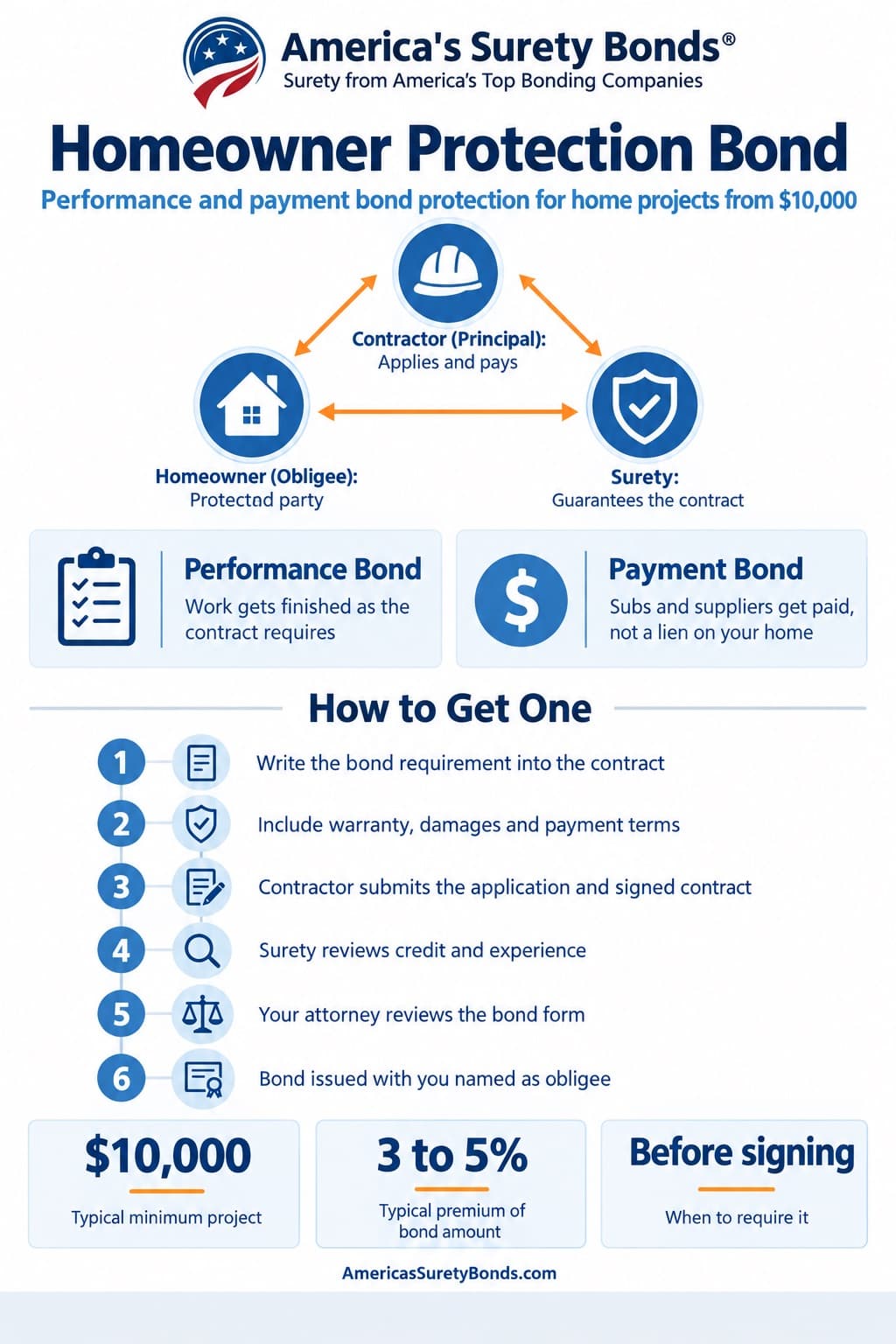
There are three parties. The contractor is the principal, the one whose promises are being guaranteed. The homeowner is the obligee, the person the bond protects. The surety is the bonding company that stands behind the contract. Homeowners can require the performance bond, the payment bond, or both.
Why Public Projects Get Bonds and Most Homes Do Not
Mike Fortney is an Ohio attorney who handles construction and business disputes for owners and contractors through his firm, Fortney Law LLC, based in Wadsworth. The firm also publishes a set of owner resources for construction projects covering what to think about before, during and after a build. In a statement for this article, he compared what the government gets on its projects with what homeowners usually get on theirs:
"Homeowners face many challenges when hiring for residential construction: from finding a reputable contractor and securing a fair price to ensuring work is completed correctly and on time. Performance and payment bonds are the single best way for homeowners to protect themselves and the project. The State of Ohio requires performance and payment bonds on public construction projects, and homeowners should demand the same level of protection for work done on their own homes."
Attorney Mike Fortney, Fortney Law LLC
Ohio law backs that up. Ohio Revised Code section 153.54 generally requires contractors on public improvement contracts to provide bond security covering both failure to perform the work and unpaid claims from subcontractors, material suppliers and laborers. So when a town builds a new garage for its snowplows, the taxpayers have a bond behind the job. When a family spends its own money remodeling its own house, there usually is nothing like that in place unless somebody asks for it.
How Performance and Payment Bonds Protect Homeowners
The Performance Bond
This one guarantees the contractor will do the work the contract describes, including any warranty work the contract requires. If the contractor defaults, the homeowner gives the surety written notice and follows the default steps in the contract and bond. The surety investigates, and if the default is valid it can help the original contractor finish, bring in a replacement contractor, or pay the homeowner, up to the bond amount.
The Payment Bond
People tend to overlook this one, and it is often the bigger risk. If your contractor collects your money but never pays the lumber yard or the electrician, those unpaid parties may have lien rights against your house. The Federal Trade Commission warns in its guide to hiring a contractor that state laws may allow subcontractors and suppliers to file a mechanics lien against your home to satisfy their unpaid bills. That is how people end up paying twice for the same job. A payment bond gives those subs and suppliers somewhere else to go besides your property.
Why a Contractor License Bond Is Not Enough
Plenty of contractors will tell you they are "licensed and bonded." In states and cities that require one, that bond is usually a license bond in an amount set by the licensing authority, and it can be shared by everybody who has a claim against that contractor. It was never sized to your project. A residential performance and payment bond is written for your contract alone, at a bond amount your contract sets. On federal jobs, the Federal Acquisition Regulation sets both bonds at 100 percent of the original contract price, and a lot of private owners use the same standard.
How to Require a Homeowner Protection Bond
Andrew D. Wyman is the managing partner of Wyman Legal Solutions, a Florida construction law firm that works with homeowners on contractor disputes, abandoned projects and construction defects. His statement for this article is about timing:
"For most homeowners, a construction or renovation project represents one of their largest financial investments, yet they often have very little protection if their contractor fails to perform. Before work begins, homeowners should require a properly structured performance and payment bond to help protect against contractor default, nonpayment to subcontractors and suppliers, and the financial disruption that can follow when a project goes wrong. A bond can provide an important additional layer of accountability and a potential source of recovery when a contractor fails to meet its obligations."
-Andrew D. Wyman, Esq., Managing Partner, Wyman Legal Solutions
Before work begins is the key phrase. Once the contract is signed and the deposit is gone, adding a bond gets a lot harder. The homeowner does not apply for this bond. The homeowner requires it, and the contractor applies. The usual order goes like this:
Before signing, write the bond requirement into the construction contract. State whether you want a performance bond, a payment bond, or both, and the bond amount. Having a construction attorney draft or review that clause is a smart move.
Make sure the contract spells out warranty periods, a liquidated damages amount and payment terms. Purchase orders and work orders do not qualify.
Have the contractor complete the Homeowner Protection Bond application and send a copy of the signed contract with it.
The surety underwrites the contractor, looking at the owners credit and their history on jobs of a similar size. The business owners and their spouses sign an indemnity agreement.
The surety provides its bond form, which your attorney can review before anything is final.
Once the premium is paid, the bond is issued with you named as obligee.
If you want to check out the surety, the U.S. Treasury keeps a list of certified surety companies anyone can search.
What a Homeowner Protection Bond Costs
Premium generally runs 3 to 5 percent of the bond amount. The contractor pays it, and the contract price can account for that cost. As a rough example, a $60,000 bond amount at those rates works out to somewhere between $1,800 and $3,000. The actual rate depends on the contractor owners credit, their experience on similar projects and how clearly the contract defines the work. Projects usually need a contract price of at least $10,000.
Next to the cost of finishing an abandoned job or clearing liens off a house, that premium is small. It is still a real number, so talk about it with your contractor before the price is set.
What the Bond Does Not Cover
A performance bond responds when the contractor fails to do what the contract requires. It is not a guarantee you will love the backsplash. If the plans are vague, it gets hard to prove what was promised, which is one more reason detailed plans, specs, a schedule and written warranty terms matter so much.
Homeowners have duties too. If the contractor walks off the job, hold the unpaid balance of the contract, because that money goes toward finishing the work. Keep paying a contractor who has already defaulted and you can weaken your own claim.
What Contractors Should Know
If you are a contractor thinking this would make a great selling point, there is a catch. You cannot buy this bond on your own to sweeten a bid. The surety only writes it when the homeowner requires it in the contract, and a request that starts with the contractor will be declined.
What you can do is be ready. Homeowners who read articles like this one are going to start asking for bonds. The contractor with good personal credit, a track record of finished jobs in that size range and a clean, detailed contract is the one who gets approved and keeps the job.
Homeowner Protection Bond FAQ
Who pays for a Homeowner Protection Bond?
The contractor applies for the bond and pays the premium. The contract price can account for that cost.
Can a homeowner apply for the bond directly?
No. The homeowner requires the bond in the construction contract, and the contractor applies. The homeowner is named on the bond as the protected party.
What is the smallest project that can be bonded?
Projects usually need a contract price of at least $10,000, and every project is reviewed individually by the surety.
Does a payment bond help with mechanics liens?
It can. A payment bond gives unpaid subcontractors, laborers and suppliers a claim against the surety, which gives them a source of payment other than your home. Lien rules are set by each state.
Put It in the Contract Before Anyone Signs
Ohio requires bonds when the government builds something. Two construction attorneys in two different states are telling homeowners to ask for the same protection on their own houses. If you have a project of $10,000 or more coming up, put the bond requirement in the contract before anybody signs.
See the full Homeowner Protection Bond details, read the Homeowner Protection Bond guide for who requires it and what it costs, browse other contract bonds, or send your contractor straight to the application.
This article is general information only and is not legal advice. The attorneys quoted provided their comments for this article and are independent of AmericasSuretyBonds.com. Bond availability, terms and pricing are subject to surety underwriting and vary by project and state.